Polyhedra as duals of a tetrahedral mesh

"popularity sits right between canonical cell type meshes and Cartesian variants"

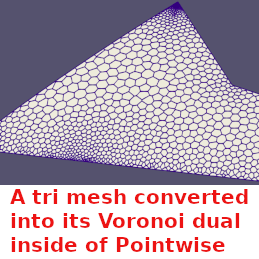
Polyhedra - both honeycomb and hanging edge - are supported by several CFD solvers. This leads to the question of what software you can use to generate these grids. That's more ambiguous than you may think: what polyhedra do you want to use in your grid? This explanation of work-in-progress shows how duality can be exploited.

In the next issue : An SU2 developer's grid-requirements

Unable to display online image


WCNs and higher-order grids

"condition number is used in Pointwise for smoothing"

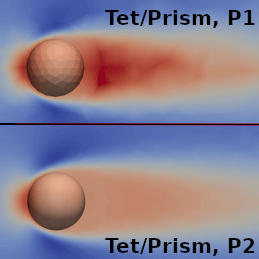
Some of FEM's advantages for CFD are related to the use of higher-order-polynomial interpolations. But creating higher-order grids for viscous flow is a challenge near highly curved geometric boundaries: high aspect ratio mesh cells can become inverted or suffer other quality problems. Read this article for details on how Pointwise uses weighted-condition-numbers to achieve high-quality higher-order cells that work great for CFD.

In the next issue: Solver-specific metric-checks

Unable to display online image


A Primer on Higher-Order Elements

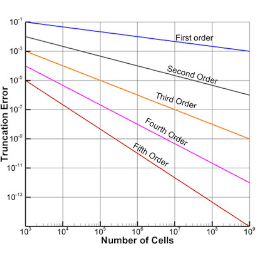
"the ability to use a coarser grid to get the same level of accuracy"

Why use higher-order elements? Not only do they pose challenges for visualization, as noted in the previous issue, they are far from being common-place. Read this article for an answer. Most users are restricted by the relative paucity of commercial higher-order CFD solvers, but that may change since a higher-order scheme gives a more accurate solution than a second-order scheme with a given grid spacing.

In the next issue: How to create histograms using Tecplot

Unable to display online image